Following on from Tuesday’s Facebook post about respite and sleepovers (Blog coming soon) , and the question of whether the odd rough patch means it isn’t working, I wanted to share a real example that shows exactly that pattern in action: Pip.
In kennels: Pip was showing repetitive behaviours, struggling to sleep, and becoming increasingly frustrated on walks. She was also losing weight. We tried bringing her into the office during the day, but spinning and barking made it hard for her to settle, and hard for anyone to get work done around her.
The intervention: A staff member started taking Pip home overnight, alongside enrichment and a designated resting pen to give her a predictable, low-arousal space.
It wasn’t instantly smooth. Her first night away, she struggled to settle. The next day back in kennels, she actually seemed worse, which, on its own, could easily have been read as “this isn’t working.” But by the second night, things had shifted noticeably, and she began to settle far more easily.
Making it transferable: a key part of Pip’s progress was that what worked at home wasn’t left there, it came back into the centre with her. Resting in a pen, increased enrichment opportunities, and familiar bedding all gave her the same cues and coping tools in kennels that she’d had success with in the home.
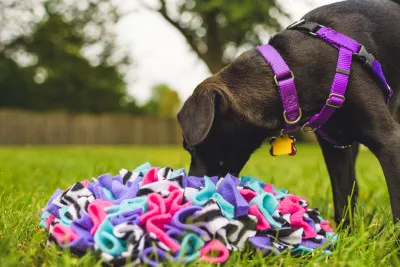
We also leaned on scent and licking-based enrichment, snuffle mats, scatter feeding, and lick mats. There’s a neuroscience reason these work so well for settling a dog like Pip: sniffing has been shown to lower heart rate and increase heart rate variability, a sign of the parasympathetic (“rest and digest”) system taking over from a stressed, sympathetic state. It also activates dopamine pathways linked to seeking behaviour, which helps buffer anxiety. Licking works on a similar principle, it’s a repetitive, rhythmic behaviour that engages the parasympathetic nervous system and is linked to endorphin release, which is part of why dogs find it self-soothing. Giving Pip these tools in both environments meant she had a genuine coping strategy she could reach for, not just a change of scenery.
From there, progress built gradually: longer stretches of calm, then time back in the office going far better than before, then a foster placement, and eventually, adoption.
Why we’re sharing this: if we’d judged the respite programme on day two alone, we might have stopped. Pip’s dip before improvement is a useful reminder that initial regression isn’t always a sign to pull back, sometimes it’s part of a dog adjusting to a new coping strategy. It’s exactly why the monitoring, enrichment and engagement piece matters so much: giving individual dogs the time and support to find what actually works for them, and making sure those tools travel with her rather than staying behind.
One more thing: we know overnight fostering isn’t always easy to resource, finding staff or volunteers who can offer it takes time and goodwill. But it’s a powerful way to widen the support network around our dogs, build genuine relationships with the community, and open the door to people who couldn’t commit to long-term fostering but can still make a real difference in short bursts. Pip is a great example of what short-stay fostering can achieve, and equally, why proper foster training matters, to support both the animals and the people caring for them.