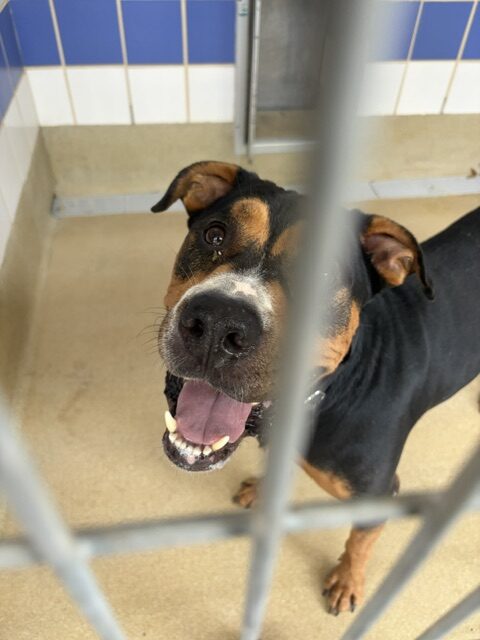
If you walk a kennel row often enough, you’ll know the sound before you see it. Barking cascading down the block as each dog reacts to the one before, sometimes before you’re even in view. It’s a hard cycle to break, and for dogs already carrying stress from kennel life, it’s one more thing working against them.
This week’s podcast episode included a lovely, small-scale example of a technique that quietly interrupts that cycle: treat to calm.
What it actually looks like
One of our guests described her own habit of it perfectly:
“I do treat for calm every time I walk up and down a kennel row to get a dog out, and the dogs never bark at me. I come into a kennel row and they’re all like, ‘we know this lady,’ even if they’ve just been barking at somebody else who walked by. They stop, because they’re like, here comes our snack friend.”
Pass a kennel, feed a treat. That’s really all it is, simple enough to remember and simple enough to actually stick to on a busy day.
Why it’s worth doing
It’s a habit several people we work with have picked up in their own kennels, and the pattern holds: treat consistently as you pass, and a dog’s response to you starts to shift. Barking that would normally greet a passer-by softens, sometimes stops altogether, because your presence has started predicting something good rather than nothing at all.
There’s also a neat efficiency to it worth flagging for busy teams. It does two jobs at once, it’s enrichment (something to anticipate, something to do with a passing human), and it’s counter-conditioning (a positive association with visitors passing the kennel), without needing a dedicated session or extra time carved out. It rides along on a walk you’re doing anyway.
How to start introducing it
- Pair it with a walk you already do. No need for a separate protocol, treat to calm works because it’s woven into normal movement through the kennel row, not a set-piece session.
- Treat regardless of behaviour, at first. The goal early on is building the association between “person walking by” and “good thing happens,” not rewarding a specific calm behaviour yet.
- Be consistent with the route. Dogs learn the pattern from repetition, the same person, the same row, treats most times they pass.
- Watch for the shift. You’re looking for the barking to soften or stop as you approach, that’s the association taking hold.
- Keep treats small and easy. This needs to be fast and low-effort enough to do dozens of times on one walk without breaking stride.
Top tips for making it stick
- Stock treat pots or bags along the block. Fixed points staff can grab from on the way past remove the “I didn’t have any on me” excuse.
- Keep a consistent treat type. Something small, low-value enough to use in bulk, and the same each time so dogs learn the pattern faster.
- Build it into existing routines. Kennel checks, cleaning rounds, handovers, anywhere staff are already walking the row is a chance to layer this in.
- Brief the whole team, not just behaviour staff. The effect is strongest when it’s not just one person’s habit, every pass counts toward the association.
- Track it loosely. Noting which dogs still react can help you spot who needs more targeted work alongside this.
It won’t replace the deeper enrichment and behaviour work some dogs need, but as a low-cost, always-on layer running underneath everything else, it’s hard to beat.
Where this fits in the bigger picture
Treat to calm isn’t a standalone trick, it sits neatly within the Open Paw framework, which focuses on shaping calm, adoptable behaviour through everyday shelter routines rather than isolated training sessions. If you want to go deeper on how these small, repeatable interactions add up to real welfare and behaviour change, we’ve covered this in more depth on the podcast:
🎙️ Supporting the Behavioural Health of Shelter Dogs 🎙️ Open Paw with Kelly Dunbar
Tell us what’s working in your kennels
Is treat to calm already part of your routine, in this form or another? We’d love to hear how it’s shaping things in your kennels, drop it in the comments.