The 5 Whys: Getting to the Root of the Problem
If you only fix what you can see, the problem comes back.
In a busy shelter, there's always something in front of us to fix. A dog isn't progressing, a plan isn't being followed, an adopter is struggling to settle a new dog. We deal with the moment, and a few weeks later, it's back.
The 5 Whys is a simple way to break that pattern. It works for dogs, for teams and for whole organisations, and it's especially good for getting a group talking.
What is the 5 Whys?
You start with a problem and ask "why?". Then you ask "why?" again about the answer, and keep going until you reach something that really explains it.
The question changes from "what's wrong?" to "what's needed?". The first answer is rarely the last one, and without the real why, we're guessing at the fix.
How to ask the whys
A few things make it work better:
- Start with what you can see. Describe the problem, not a label. "Barks and lunges when he sees another dog" is more useful than "reactive". "Plans aren't being completed" is more useful than "the team doesn't care".
- Make each answer the next question. Take your answer and ask why about that, not about the original problem.
- Stick to what you've observed. If you're guessing, say so, then check it with video, notes or someone who sees things from a different angle.
- It's fine to branch. Sometimes a why has two answers. Follow both and see where they lead.
- Stop at something you can act on. Five is a guide, not a rule. Sometimes it takes three, sometimes seven. A good test is to ask, "if we changed this, would the problem change?"
Things to watch for
- Stopping at a label. "He's dominant", "she's stubborn" and "they don't care" feel like answers, but they don't explain anything. If a why ends in a label, ask why again.
- Jumping to the fix. It's tempting to solve it at why 2. Keep going until you know what you're solving.
- Blame. The aim is to understand, not to find someone at fault, whether that's the dog, the handler or the kennel.
Why it works so well in groups
The 5 Whys is useful on your own, but it comes into its own with a team. Here's why:
- Different people see different things. The person who walks the dog, the person who cleans the kennel and the person who reads the notes each hold a different piece of the picture.
- Everyone gets a voice. Writing answers on post it notes means quieter people contribute as much as louder ones, and nobody has to defend an idea before it's on the wall.
- It keeps the talk on the why. Groups tend to leap to solutions. The structure holds everyone at the question until the answer is clear.
- It takes the blame out. When you're all looking at the wall together, it's about the problem, not about a person.
- The differences are the point. Split into small groups and you'll often find that each one takes a different route. Comparing them shows you more than any one chain would.
A simple way to run it is to split into groups of three to five, give each group the same problem, and let them write their whys on notes, one per note, in their own columns. Then compare the columns together, look for themes, and agree actions.
Example 1: Rory, the dog who wanted to say hello
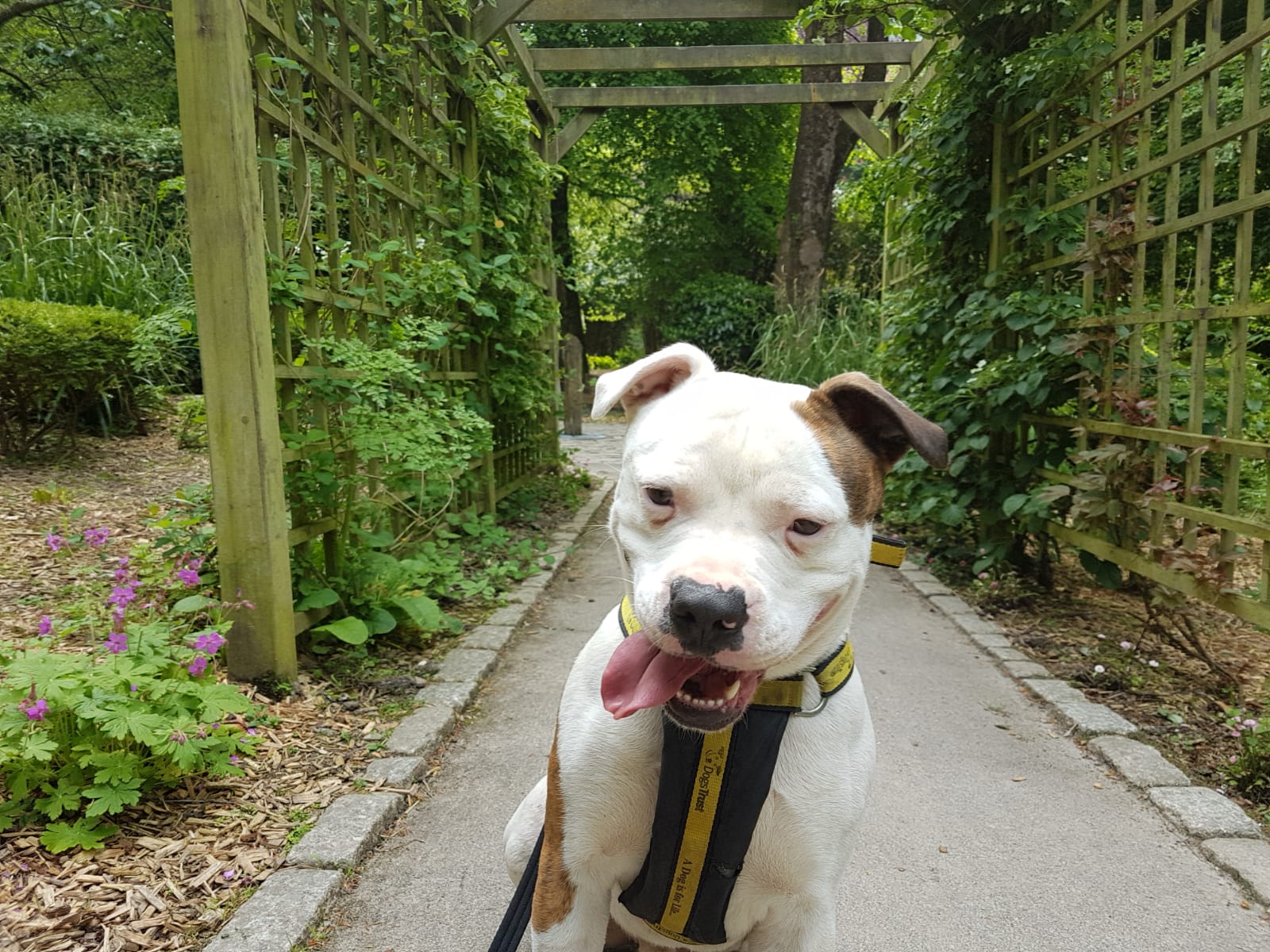
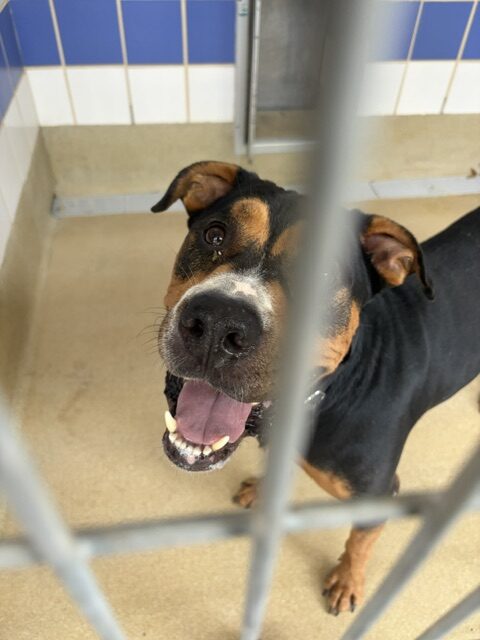
Rory's notes said he was difficult around other dogs, as well as around people and busy places. When he saw a dog, he reacted. Here's what happened when we kept asking why.
The problem: Rory is reactive when he sees other dogs.
Why 1: Why is he reacting? Because he's overwhelmed in the situation.
Why 2: Why is he overwhelmed? Because he's not sure how to act.
Why 3: Why isn't he sure how to act? Because he wants to meet other dogs, but doesn't know how. His body language showed a dog who wanted to go towards other dogs, not away from them. It was frustration, not fear or aggression.
Why 4: Why doesn't he know how? Because he's had very little chance to learn. There's little dog contact in a kennel, and because his notes said he was difficult around dogs, the safest choice had been to keep him away from them.
Why 5: Why does that matter for the plan? Because the usual plan, keeping distance and teaching a different behaviour, suits a frightened dog. For Rory it would have left his real need untouched.
The root: Rory wasn't a dog who needed to be kept away from other dogs. He was a dog who needed a safe, appropriate way to meet them. The goal changed from "stop the reacting" to "find a way to say hello".
So we started careful introductions, gave him real, appropriate dog play so his social needs were met, and worked on how he felt on lead alongside it. The result was improved welfare as much as improved behaviour: a dog whose social needs were finally being met.
Example 2: Why aren't behaviour modification plans being completed?
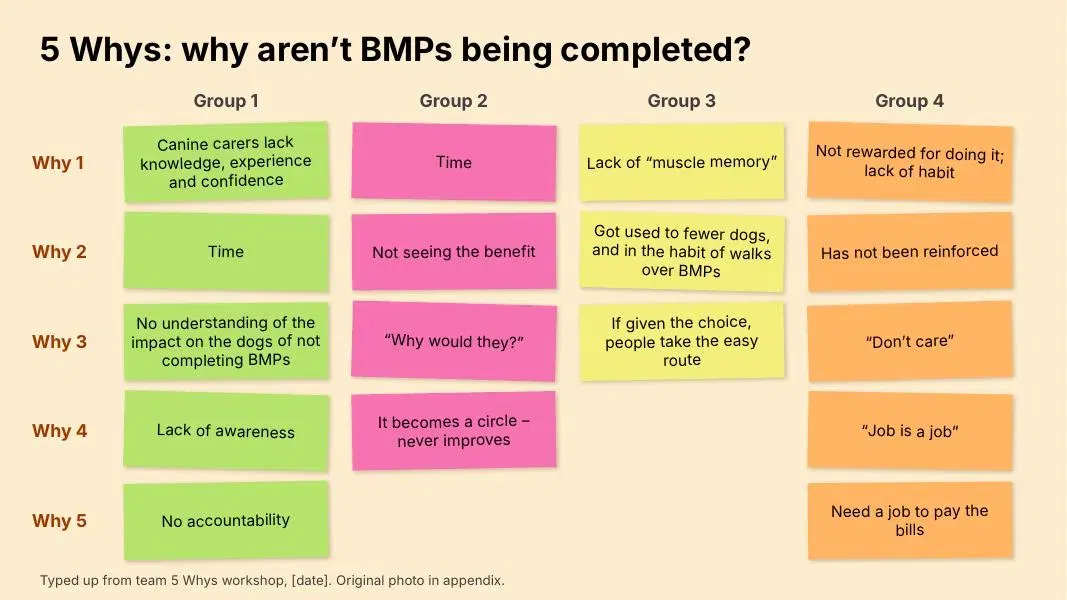
Not every problem is about a dog. In a team workshop, we asked: why aren't behaviour modification plans (BMPs) being completed? Four groups worked on it separately, with their whys on post it notes.
Here's where each group ended up:
Group 1: Canine carers lack knowledge, experience and confidence, then time, then no understanding of the impact on the dogs of not completing BMPs, then lack of awareness, and finally no accountability.
Group 2: Time, then not seeing the benefit, then "why would they?", and finally a circle that never improves.
Group 3: Lack of "muscle memory", then people got used to fewer dogs and the habit of walks over BMPs, and finally, if given the choice, people take the easy route.
Group 4: Not rewarded for doing it and no habit, then it hasn't been reinforced, then "don't care", then "a job is a job", and finally the need for a job to pay the bills.
Four groups, four different routes, and each one found something the others didn't. A few things stand out:
- Nobody's answer was "they're lazy". Between them, the groups pointed to knowledge, confidence, time, not seeing the benefit, habit and a lack of reinforcement. Those are things a team can change.
- The uncomfortable answers are useful. "Don't care" and "a job is a job" aren't easy to write on a wall, but they were honest, and it's much better to have them in the open than to suspect them.
- It's the same science we use with dogs. Groups 3 and 4 landed on habit and reinforcement. If a behaviour isn't reinforced and isn't a habit, it doesn't happen, whether the learner has four legs or two.
The next step is to turn the themes into actions, such as making the benefit visible, building the plans into the daily routine, recognising the team when they get it done, and agreeing who's accountable for what. [ADD: what the team did next]
How we use it
We use the 5 Whys in three places:
- In the kennels, to look past a dog's behaviour to the stress, routine or environment behind it.
- With adopters, to work through settling in challenges and find practical solutions that keep dogs in their homes.
- Across the organisation, to find out why a process keeps breaking down, so we can fix the system, not just the moment.
Try it this week
Pick one problem in your shelter, whether it's a dog, a process or something that keeps coming back. Put a few colleagues in a room, write down what you can see, and ask why, five times. Put each answer on a post it note and see what you find at the bottom.
What problem would you take through the 5 Whys? Tell us in the comments.
If you need support with your team or a dog in your care, click the button below.

0 Comments